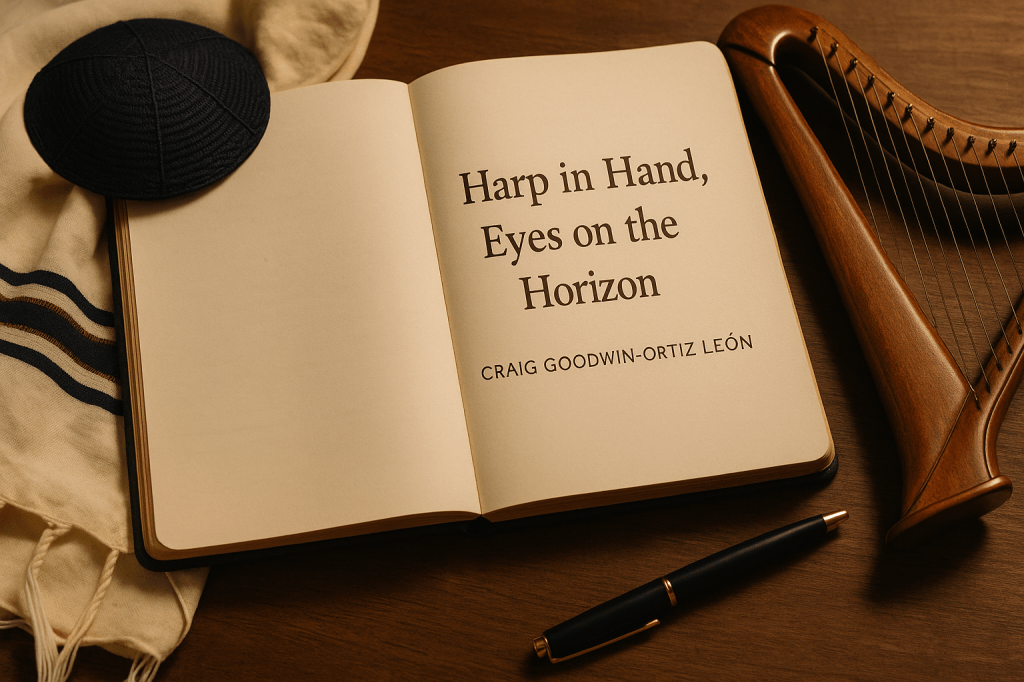
Harp in Hand, Eyes on the Horizon
By Craig Goodwin-Ortiz de León
Lectionary Readings for July 10, 2025 – Thursday after the Fourth Sunday after Pentecost (Proper 9):
Psalm 18: Part II; 1 Samuel 16:14–17:11; Acts 10:17–33; Luke 24:36–53
Some days I feel more like David with a harp than a warrior with a sword. This evening’s readings reminded me that God often begins by forming us quietly, not publicly. David is first called not to slay giants but to soothe a troubled king. Before he becomes a hero, he is a musician. Before he is a leader, he is a servant. That image stays with me. In my daily life—whether I am praying wrapped in my tallit or reviewing contracts and grant reports—I feel the quietness of that kind of preparation. It isn’t flashy. But it is faithful. And faithfulness, I’m learning, is the starting point of call.
The psalmist’s words in Psalm 18 are vivid, even jarring at times, but they are ultimately about trust. He writes from the perspective of one who has endured hardship and emerged stronger, not by his own strength but by God’s. “You, O Lord, are my lamp; my God, you make my darkness bright.” That line hit me deeply tonight. It reminded me that the strength I need as a deacon in formation doesn’t come from charisma or certainty. It comes from light—God’s light, shining into the daily work, the hard conversations, and the invisible labor of love. God makes my footing secure even when I am not sure of the path ahead.
Acts 10 stretches me in the way I most need to be stretched. Peter is confused by a vision and unsure of what to do, but he listens. He goes without knowing why. When he arrives at Cornelius’s house—a place he never thought he’d enter—he realizes that God is already at work there. “God hath shewed me that I should not call any man common or unclean.” That line speaks directly to my vocation as a deacon, which calls me to move between the church and the world, across boundaries that others may hesitate to cross. Whether I am serving immigrants, advocating for justice, or sitting with someone in spiritual pain, I want to carry that same openness: to go where God sends me, and to recognize the holiness that’s already there.
In Luke’s Gospel, Jesus appears and offers peace before explanation. The disciples are terrified, and he responds by showing his wounds. He doesn’t rush to teach. He invites them to touch, to see, and even to feed him. Only then does he open their minds to understand the scriptures. This slow, embodied approach moves me. It reminds me that resurrection is not just a doctrine; it’s a presence. And that presence brings joy. Jesus sends them back into the world not with answers, but with blessing. That is the kind of witness I hope to bear—a deacon who walks with people in their fear, shows up with gentleness, and makes space for the Spirit to open hearts in God’s time.
I may not know exactly what lies ahead, but I am being shaped in the quiet. The Spirit is preparing me through the work I do, the prayers I pray, and the people I serve. My task is to keep saying yes—to hold the harp, to pray the psalms, to follow the Spirit’s leading when it asks me to cross lines I never thought I’d cross. In that obedience, I trust that God will give me firm footing. As the psalmist writes, “He makes me sure-footed like a deer and lets me stand firm on the heights.” That promise is enough for now. And that promise is joy.
 Under the Fig Tree