Bless the Lord, O My Soul
Why we bless God in our prayers
By Craig Goodwin-Ortiz de León, PhD
One of my earliest encounters with the Psalms didn’t come in church or in a Bible study—it came from the Broadway stage. I’ve loved the musical Godspell since I was young, and one of its most joyful moments is the song “O Bless the Lord, My Soul.” With its gospel rhythms and exuberant energy, the song captures something essential about what it means to turn toward God with praise. Even before I fully understood the theology, I could feel the truth in that music: that blessing God was not about obligation, but about joy. That song planted a seed in me, and over the years, I’ve come to understand that beginning prayer with blessing—blessing God first—is a deeply transformative act.
We often begin our prayers by asking God for something: healing, strength, peace, guidance. But the ancient rhythm of prayer begins not with requests, but with blessing. We bless God before meals, at the opening of liturgy, and even in the quiet stillness of personal devotion. This might seem odd at first—after all, how can we bless the one who blesses us? Yet scripture and tradition teach us that blessing God is not only appropriate; it is the foundation of a life rooted in praise.
To bless God is to remember who God is and who we are in relation. The act of blessing redirects us from self-centeredness toward divine-centeredness. In saying “Bless the Lord,” we do not offer something God lacks; we name the truth of God’s goodness, sovereignty, and glory. We also name our own creatureliness—our dependence, our humility, and our gratitude. In blessing God, we take our place within the order of creation, joining the psalmist who cries out, “Bless the Lord, O my soul, and all that is within me, bless his holy name” (Psalm 103:1).
Jesus himself teaches this pattern of prayer. In the Gospel according to Matthew, Jesus blesses God before meals, before miracles, and in the most intimate moments with his disciples. “He took the seven loaves and the fish, and after giving thanks he broke them and gave them to the disciples” (Matthew 15:36). At the Last Supper, he again blesses and breaks bread. These actions reveal a consistent posture: Jesus begins by blessing God. This was not an empty ritual but an expression of reverent communion with the One he called Father. When we bless God first, we begin from a place of trust and praise rather than fear or control.
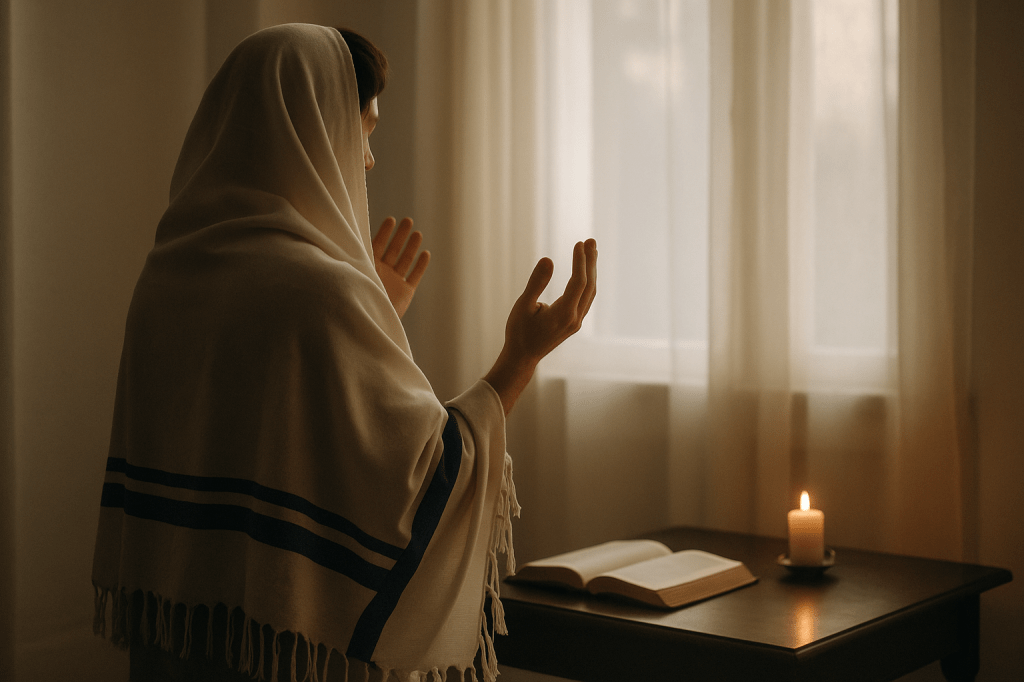
This ancient pattern finds expression in Jewish tradition as well. Every blessing begins with the words: Baruch atah Adonai Eloheinu, Melech ha’olam—“Blessed are You, Lord our God, King of the Universe.” These words are spoken before meals, during Sabbath observances, and in daily prayer. They are also prayed when one wraps themselves in the tallit, the fringed prayer shawl commanded in the Torah. The blessing for this act is deeply reverent: “who has sanctified us with His commandments and commanded us to wrap ourselves in the fringes.” Though I am not Jewish, I have incorporated this prayerful gesture into my Christian practice as a sign of covenant and righteousness. Each morning, I place the tallit over my shoulders and bless God, recalling both my adoption into the family of faith and my longing to walk in holiness.
I understand this may seem unusual, even jarring, to some. But for me, praying with tzitzit is not an appropriation of another faith; it is a way of honoring the deep roots of my own. Jesus wore tzitzit. Paul was raised in their presence. They remind me that righteousness is not earned, but worn as a gift. In the Book of Revelation, we are told that those who follow the Lamb are clothed in white robes, washed in his blood (Revelation 7:14). When I wrap myself in the tallit, I am reminded of that robe. I bless God for the righteousness given to me through Jesus Christ—a righteousness not of my own making, but freely offered by grace.
The liturgy of the Church teaches us to begin with blessing. At the start of nearly every Episcopal service, we proclaim, “Blessed be God: Father, Son, and Holy Spirit.” This is not a mere formality. It is an act of spiritual alignment. Before we confess our sins, before we hear the Word, before we come to the Table, we orient ourselves in praise. The Book of Common Prayer deepens this pattern through the use of proper prefaces—seasonal prayers of thanksgiving spoken before the Eucharist. The preface for God the Father offers this praise: “For you are the source of light and life, you made us in your image, and called us to new life in Jesus Christ our Lord.” These words bless God by naming God’s creative power, self-giving love, and desire for our renewal. When we pray them, we are not just remembering doctrine—we are blessing the God who made us and is remaking us still.
This practice of blessing has changed the way I pray. It slows me down. It softens my heart. It opens me to the mystery of God’s presence in the ordinary. When I begin with blessing, I find that my prayers are less anxious and more honest. I do not rush to fix things or prove myself. I simply return to the One who is worthy of praise, and I find myself once again held in love.
It turns out that the song I loved in Godspell was telling the truth all along. Blessing the Lord is more than a lyric or a liturgical phrase—it is a way of life. So I invite you to reflect: Do you begin prayer with blessing? Are there phrases, traditions, or gestures that help you remember who God is and who you are in relation? Whether you come from a liturgical background, another tradition, or are still exploring what prayer means for you, I’d love to hear your experience. Share in the comments or send me a message. Let’s learn from one another—and let our souls, together, bless the Lord.
 Under the Fig Tree