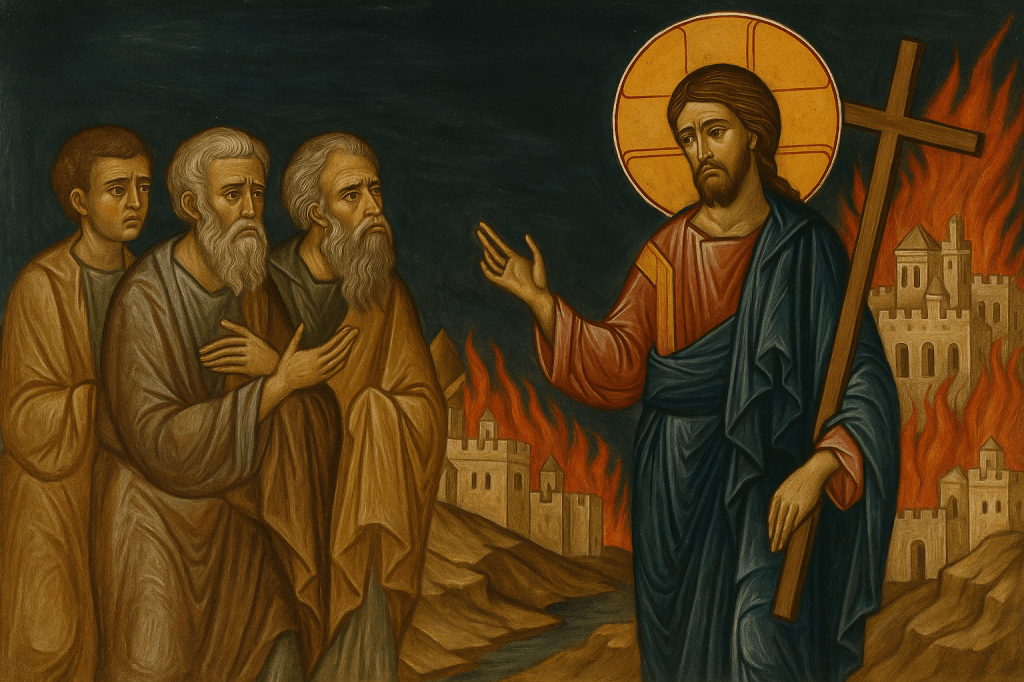
Amos Prophesied to the 21st Century
by Dr. Craig Goodwin-Ortiz de León, PhD
Today in church, we read Amos 8, and I felt the air shift. The passage begins with an image that seems harmless at first—a basket of summer fruit. But God reveals that this fruit signals the end. The word for “summer fruit” in Hebrew, qayitz, sounds like qetz, meaning “end.” God is telling Amos that the people have ripened for judgment. Their society has reached a tipping point. Injustice has fermented. The harvest is ready, but it is not a feast of blessing. It is the moment when God can no longer overlook their corruption.
The verses that follow hit with full force. The people trample on the needy and ruin the poor. They complain about holy days because those observances interrupt their schemes to exploit others (remember when businesses were closed on Sundays?). They manipulate the scales. They buy and sell human beings as if they were products. The economy thrives on oppression, and religion has become a ritual devoid of righteousness. God’s anger burns against this kind of world. And as I sat in the pew, I thought: this is the world we live in right now.
We are living in a time that mirrors the sins Amos condemned. The United States tolerates and even celebrates extreme wealth while families go hungry. Politicians invoke God while passing policies that harm the poor, immigrants, LGBTQ+ people, and people of color. Many who call themselves Christians do not live according to Christ’s teachings. They claim the name of Jesus, but they do not follow him. They do not go to church, they do not pray, and they do not serve. Their faith is cultural, not covenantal. We have turned God into a mascot for empire. We have traded righteousness for reputation and mercy for power.
God will not bless a nation that clings to injustice. Amos makes it clear that covenant does not guarantee immunity from judgment. God judged Israel, the chosen people, for failing to uphold justice. He will hold every nation accountable by the same measure. That includes the United States. That includes modern-day Israel. When any government abuses its power, dehumanizes others, and twists religion to justify violence, it places itself in direct opposition to the heart of God.
I felt another echo while reflecting on Amos—this time from the Book of Joel. Joel, like Amos, warns of judgment, but he speaks through the image of natural disaster. Locusts devour the land. The sun darkens. Creation itself groans. Joel’s call is urgent and communal. He urges the people to return to God with all their hearts. He calls for repentance that goes beyond rituals. He says, “Rend your hearts, not your garments.” His message is clear: God will restore, but only if we turn. We must take our sin seriously before healing can begin.
Amos and Joel together speak a truth we often ignore. They remind us that God’s mercy cannot be separated from God’s justice. They teach that judgment is not simply punishment. It is a wake-up call. It is God saying, “Enough.” The suffering we see today—the inequality, the violence, the despair—is not just the product of political failure. It is the spiritual consequence of turning away from God’s commands. We have not loved our neighbors. We have not cared for the vulnerable. We have worshiped idols of wealth, control, and self-interest.
Jesus stepped into this broken world and stood in the same prophetic tradition. In the Sermon on the Mount, Jesus does not dismiss the prophets. He fulfills them. He gathers the people and begins by blessing those the world overlooks: the poor, the mourners, the meek, the merciful, the peacemakers. These beatitudes are not sentimental sayings. They are revolutionary declarations. Jesus lifts up those whom society crushes. He calls his followers to live in a way that confronts systems of exploitation and prioritizes compassion over conquest.
The Sermon on the Mount demands a radical kind of discipleship. Jesus tells us to love our enemies, to give without expecting anything in return, and to pray in secret rather than perform piety in public. He reminds us that we are the salt of the earth and the light of the world. These words challenge every comfortable faith that hides behind a flag or a pew. They confront every Christian who refuses to act while their neighbor suffers. Jesus calls us to a life of visible, active love.
All of this leads us to the cross, the turning point of history. On the cross, Jesus bears the weight of human sin and systemic evil. He suffers unjustly, crucified by empire and condemned by religion. Yet in his suffering, he does not curse his enemies. He forgives. He absorbs violence without replicating it. The cross exposes the cruelty of power and the depth of divine mercy. It stands as the ultimate rebuke to counterfeit religion. It shows us what justice and love look like when they meet.
After the cross, the story continues in Revelation. Jesus rises from the dead, not as a conqueror who crushes others, but as the Lamb who was slain. He is worthy because he gave everything. Revelation declares that one day, every empire will fall. Babylon will collapse. The powers of this world will face judgment. A new heaven and a new earth will come. God will dwell with us. The tears of the poor will be wiped away. Death and mourning will be no more.
This is a message of hope, but only if we repent. God’s promises are not unconditional affirmations. They require a response. The same Spirit that Joel promised and Jesus gave now calls us to act. We cannot claim to follow Christ while ignoring the cries of the oppressed. We cannot hope for heaven while building hell for others on earth. If we want to live in the kingdom of God, we must live as citizens of that kingdom now.
So what can we do in the face of so much evil? We begin by living out the gospel in tangible ways. We feed the hungry. We welcome the stranger. We advocate for justice. We confess our complicity. We dismantle systems that harm and rebuild structures that heal. We listen to the prophets. We follow the teachings of Jesus. We live by the power of the Spirit. This is not abstract spirituality. This is faith with flesh on it.
God is still speaking through Amos, Joel, Jesus, and Revelation. The message has not changed. Justice still rolls like water. Mercy still triumphs over judgment. The cross still calls us to surrender our pride and pick up the work of love. The Lamb still reigns. And the Spirit still empowers us to build a better world—one act of compassion at a time.
We are not helpless. We are the people of God. Let us rise. Let us repent. Let us love.
 Under the Fig Tree