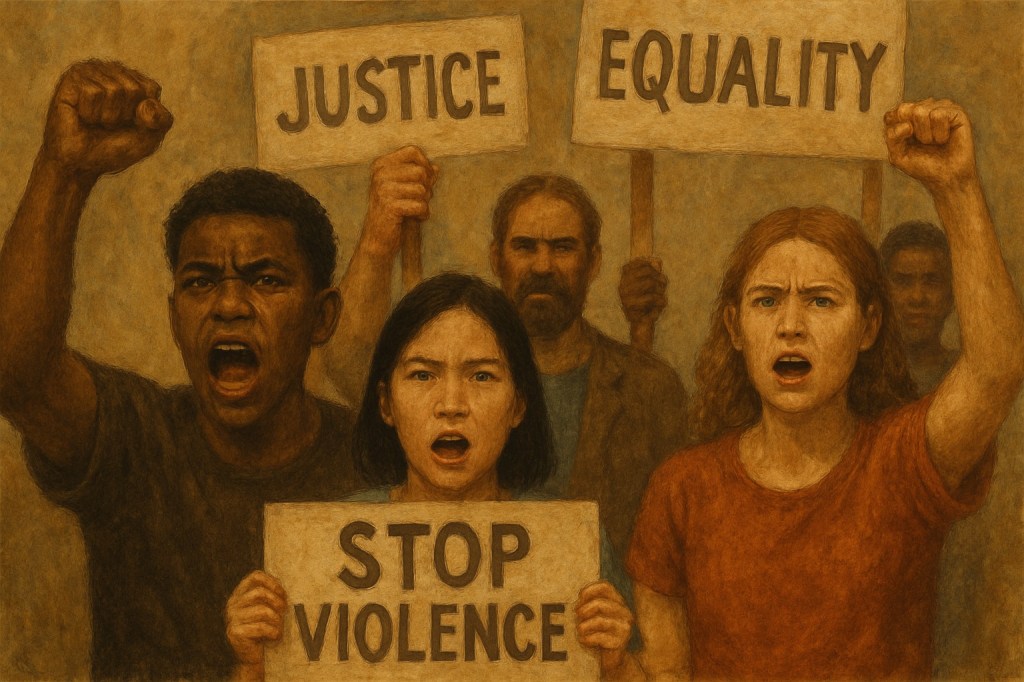
During Bible study this week, I found myself sitting quietly while others discussed Chapter 2 of Brian K. Blount’s Can I Get a Witness? Reading Revelation through African American Culture. They offered insights that felt far more sophisticated than anything I could say. Then one phrase stopped me cold — Blount’s description of “plasma detergent” — and the discussion about who defines “violence” in resistance opened a flood of memory. I thought of the summer of 2020, when I said that people should not resort to violence during the Black Lives Matter protests. I was accused of being racist. At the time, I felt misunderstood. Today, I am not so sure.
Blount’s reading of Revelation helped me see that the question of who defines violence is not neutral. He argues that “the empire defines violence as anything that disrupts its control” while oppressed communities experience violence daily in the form of systemic harm, exclusion, and death. In John’s vision, violence is not only physical force but also the grinding, hidden destruction of human life by powers and principalities. The Lamb’s triumph is not polite accommodation but decisive confrontation with those powers. This is not an endorsement of bloodshed, but it is a recognition that resistance, especially faithful resistance, will unsettle the world order.
Looking back to 2020, I now hear my words differently. I thought I was calling for peace, but I was actually focusing on visible unrest — broken windows, confrontations in the street — without naming the centuries of violence that sparked it. By doing so, I echoed the empire’s definition of violence: the disruption that threatens comfort, not the harm that has been eating away at Black lives for generations. In my desire to avoid conflict, I failed to see the deeper conflict already underway.
Blount’s imagery in Revelation reminds me that the greatest violence is not the protest that makes headlines, but the oppression that rarely does. The beasts and Babylon represent systems that devour life daily while appearing orderly and respectable. John’s vision calls the church to bear witness against these powers, even when that witness looks like disruption to those who benefit from the status quo. This is why, as Blount notes, “The Lamb conquers not by avoiding the confrontation but by engaging it on God’s terms.”
I still long for peace, but not the false peace that props up injustice. My prayer now is for the kind of peace that comes only when the deeper violence is ended — the peace of the New Jerusalem, where every tear is wiped away and no one is left outside the gates. That peace may require disruption, risk, and costly love. It may look like raising my voice when I would rather be silent. It may mean standing alongside those whose resistance unsettles me. As Revelation teaches, the witness of the Lamb is not safe, but it is faithful. The real question is: whose definition of violence will I follow — the empire’s, or the Lamb’s?
 Under the Fig Tree