By Craig Goodwin-Ortiz de León
“Let justice roll down like waters, and righteousness like an ever-flowing stream.” – Amos 5:24
Today marks my first day of orientation at Union Theological Seminary, and I carry with me a sacred mix of excitement, humility, and awe. This moment has been a long time in the making, not just in terms of logistics or academics, but in the deeper stirrings of my spirit. The path to this place has been paved with prayer, discernment, and a growing call to reimagine what it means to follow Jesus. At the center of that call is Union’s invitation—more than a slogan, really—to “Reimagine the work of Justice.” I do not take this lightly. These words have already begun to shape me, and I expect they will challenge me even more in the months and years ahead.
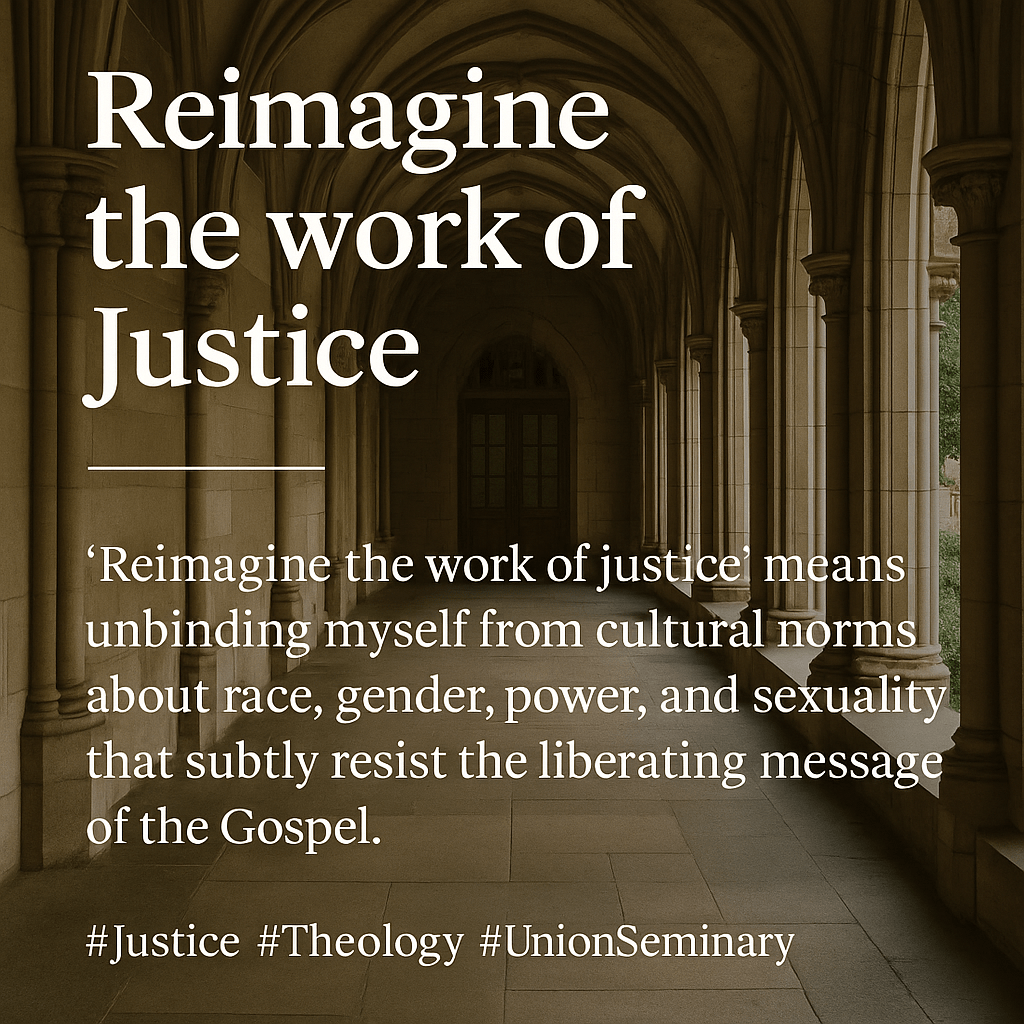
To reimagine the work of justice is to take a searching look at my own formation and unearth the assumptions that have quietly shaped my sense of what is right, fair, or possible. Some of those assumptions are tied to systems I did not choose but that nonetheless live in me: cultural norms about race, gender, power, and sexuality that subtly resist the liberating message of the Gospel. As a white, cisgender gay man married to an immigrant of color, I live at a complex intersection of privilege and marginalization. Part of my formation as a deacon is to hold that tension honestly. Reimagining justice means confronting not only what has harmed me, but also what I have absorbed or perpetuated without realizing it. This unbinding is deeply personal—and it is sacred.
This path of study and ministry will not be easy. Balancing seminary with full-time work and vocational discernment is already stretching me, and I know it will demand more from me than I can currently imagine. I will have to wrestle with difficult texts, examine painful histories, and open myself to the witness of communities whose truths may unsettle me. I will need to pray more deeply, rest more intentionally, and be gentle with myself as I grow. The truth is, I cannot walk this road alone. I will need the companionship of the Spirit, the support of my loved ones, and the guidance of those who have walked this road before me. And still, I choose this path because I believe it leads me closer to God’s heart.
Union’s call to reimagine justice is not merely academic or political—it is theological. It is a summons to root justice in love, in covenant, and in the vision of the Kingdom that Jesus preached. As a deacon-in-formation, I feel called to stand at the threshold between the Church and the world, helping both to see and respond to the image of God in places we have too long ignored. The Baptismal Covenant asks us, “Will you strive for justice and peace among all people, and respect the dignity of every human being?” My answer is yes. But that yes must be lived out—not only through advocacy or service, but through a transformed heart, a renewed mind, and an imagination set on fire by the Gospel.
As I begin this new chapter at Union Theological Seminary, I carry with me the waters of baptism and the words of the prophet Amos. I believe that justice must roll—not in thin, predictable streams, but in wild, living torrents that wash away fear and nourish hope. I believe that the work of justice must be reimagined again and again, in every generation, in every place, and in every soul. And I believe that the Church has a role to play in this holy work—not as an institution of control, but as a community of courage, compassion, and truth. This is the work to which I am called. And it begins today.
 Under the Fig Tree