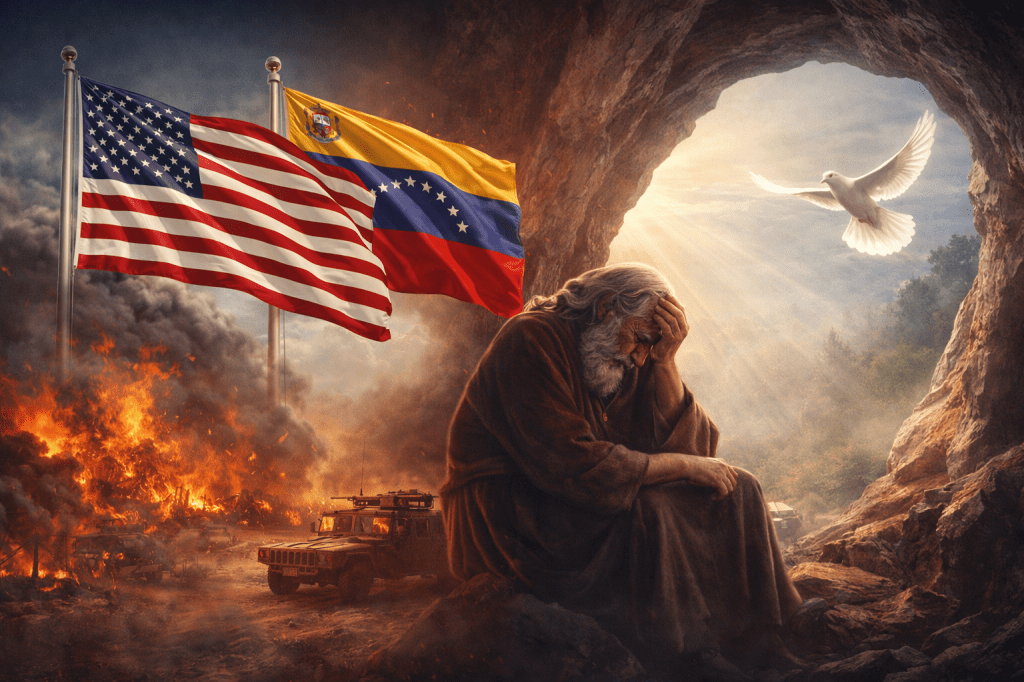
The Still Small Voice in a World of Empires
The Still Small Voice in a World of Empires
I am trying to sit with what happened today before reacting too quickly or too loudly.
The United States used military force in another country, removed its sitting president, and then announced that we will
“run the country” until a satisfactory leader can be found. However flawed or contested Venezuela’s election may have
been, it remains a sovereign nation with its own people, history, and political life. Declaring external control over
another nation is not a neutral or temporary act. It is an occupation. Occupation always carries moral weight because it
replaces consent with coercion and self-determination with control.
There is a kernel of truth that deserves to be named honestly. Venezuela has been deeply implicated in regional drug
trafficking, and corruption within state structures has contributed to real harm, including harm felt here in the United
States. Drug violence destroys lives, families, and communities. Ignoring that reality helps no one, and moral seriousness
requires that we tell the truth about the damage caused by criminal networks and state corruption. Christians should never
confuse compassion with denial.
But naming that truth does not resolve the ethical question before us. Criminality and contested elections do not grant
another nation moral authority to depose a government and assume control over a people’s future. When one country declares
that it will govern another until it approves of the outcome, democracy becomes conditional and sovereignty becomes
negotiable. That logic does not strengthen international order. It weakens it, because it teaches that power rather than
law determines legitimacy.
We also have to be honest about what often accompanies these interventions. Powerful nations rarely act without material
interests at stake. Venezuela’s vast oil reserves cannot be separated from this conversation. History offers little reason
to believe that economic appetite is unrelated to moral language when intervention is proposed. When real wrongdoing is used
to justify domination and extraction, injustice is not resolved. It is redistributed.
Christians should recognize this pattern immediately. Empire has never been good for Indigenous peoples. It displaces them,
silences them, and reframes their survival as an obstacle to progress. Even when empire claims to bring order or
prosperity, those benefits are imposed rather than chosen and are purchased through dispossession, cultural erasure, and
violence. If empire were truly benevolent, it would not require force to sustain itself. It would not fear consent. It
would not erase memory.
Today’s Office reading from First Kings makes this moment even more searching. Elijah, exhausted and afraid after
confronting violence and power, hides in a cave. He expects God to arrive the way power usually arrives, with spectacle and
force. A great wind tears the mountains apart, but the Lord is not in the wind. An earthquake shakes the ground, but the
Lord is not in the earthquake. Fire blazes, but the Lord is not in the fire. Only after all of this comes the sound of
sheer silence, the still small voice, and Elijah covers his face because he knows God is there.
That passage should form Christian conscience in moments like this. Empires announce themselves loudly. They arrive with
force, certainty, and declarations that they will “run” things until order is achieved. God refuses those forms. Divine
authority does not occupy or coerce. It speaks quietly, leaving room for listening, repentance, and freedom. Scripture
consistently resists the belief that power justifies itself.
The Apostle Paul captures this ethic with clarity when he writes, “Do not be overcome by evil, but overcome evil with good”
(Romans 12:21). That command assumes restraint and faithfulness in how power is exercised, not only in what outcomes are
desired. The prophet Micah sharpens the point even further: “What does the Lord require of you but to do justice, to love
mercy, and to walk humbly with your God” (Micah 6:8). There is no humility in occupation. There is no mercy in deciding
another people’s future without them. Justice cannot be imposed at gunpoint.
Jesus himself rejected the logic of empire when it was offered to him. He refused to rule by domination and chose instead
the slow and costly way of truth, faithfulness, and love. Christians cannot invoke his name while blessing a politics that
treats control as moral clarity.
I do not pretend that any of this is simple. Corruption is real. Violence is real. Suffering is real. But Scripture teaches
us that God is rarely found where power insists He must be. The still small voice speaks against the assumption that force
saves, that occupation heals, or that greed can be baptized into righteousness.
If we truly care about democracy, justice, and human dignity, then occupying a country and announcing that we will “run it”
should trouble us deeply. A world governed by law and moral restraint is not built through empire. Today’s actions deserve
sober reflection, ethical clarity, and prayerful listening for the voice of God that does not shout, but still speaks.
 Under the Fig Tree
Response
You should read Martin Luther on just war theory https://standingbeforegodblog.wordpress.com/2026/01/03/war-against-universal-world-wide-lack-of-peace-martin-luther/
LikeLike