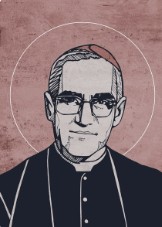
Saint Óscar Romero (1917–1980)
Archbishop of San Salvador, Martyr for Justice
Saint Óscar Arnulfo Romero was born on August 15, 1917, in Ciudad Barrios, a small town in eastern El Salvador. He grew up in a working-class family, one of eight children, and was apprenticed to a carpenter before discerning a call to the priesthood. Ordained in 1942 after studies in Rome, Romero was known in his early ministry for his personal piety, pastoral devotion, and theological conservatism. For much of his career, he avoided political controversy and was considered a safe and moderate voice within the Salvadoran Church.
By the 1970s, El Salvador was on the brink of civil war. Deep economic inequality, government repression, and a rising tide of liberation movements created a volatile and violent environment. The Catholic Church, particularly the Jesuits and other pastoral leaders influenced by liberation theology, began to stand more openly with the poor. Many priests and lay leaders were accused of fomenting rebellion simply for organizing peasant communities or defending human rights. Romero, appointed Archbishop of San Salvador in 1977, was initially seen as a counterweight to these more progressive clergy.
Everything changed when his friend and fellow priest, Father Rutilio Grande, was murdered by government-aligned forces for his advocacy among the rural poor. Romero’s grief catalyzed a transformation in his ministry. He began to use his position to denounce systemic injustice and defend those targeted by the state. His weekly homilies, broadcast on the radio and closely followed by both the poor and the powerful, became a voice of truth in a culture of fear. His public condemnation of torture, assassinations, and disappearances placed him in direct opposition to the ruling elite. The Church itself became a target, with Jesuits and other clergy harassed, detained, or killed. On March 24, 1980, while celebrating Mass at the altar of the Divine Providence Hospital chapel, Romero was shot and killed by a government death squad. He died as he lived in those final years: a shepherd who refused to abandon his flock.
Romero’s legacy continues to inspire movements for justice and reconciliation around the world. He has become a symbol of prophetic courage and moral clarity in the face of violence and oppression. His life challenges the Church to stand with the marginalized, to speak out when silence is safest, and to remember that the Gospel is not neutral in the presence of suffering. The Episcopal Church first added Romero to its calendar of commemorations on a trial basis in 2009, and he was given a permanent place in Lesser Feasts and Fasts in 2018. Canonized by the Roman Catholic Church later that same year, he is now honored across denominations as a saint for the poor, the persecuted, and all who seek peace rooted in justice.
Originally written on 6/30/2025 and published in the service bulletin at St. Andrew’s Episcopal Church, New Providence, NJ on 8/31/2025.
 Under the Fig Tree
Leave a comment