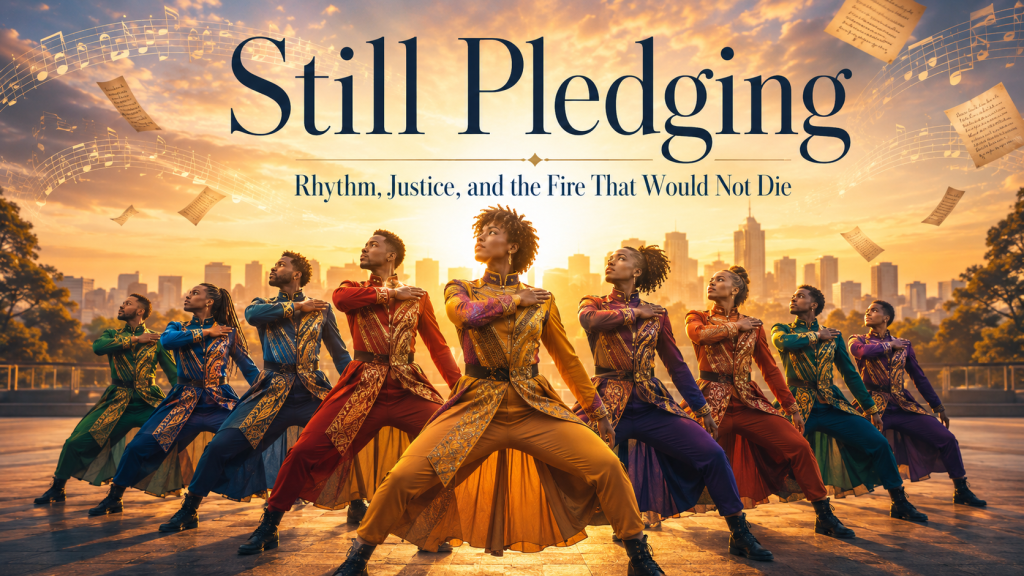
Still Pledging: Rhythm, Justice, and the Fire That Would Not Die
A reflection on Rhythm Nation 1814, prophetic tradition, justice, and Christian vocation.
I was a twelve-year-old boy when I first heard it, and I believed my generation was going to change the world. I believed we would be the ones to finally end racism and poverty. I believed that if enough people saw clearly, moved together, and refused indifference, the world could become something different. I was young, but I loved humanity. Even then, I understood that God loved creation and expected us to love one another. I did not yet have the theological language to explain it, but I knew that racism, poverty, violence, and cruelty were violations of something sacred. They were not merely social problems. They were refusals of love.
Inside the cassette tape jacket was a creed that I still have memorized:
Music.
Poetry.
Dance.
Unity.
Those four words formed something in me. They taught me that justice is not only argued into existence. It is sung, danced, embodied, imagined, and practiced. They taught me that movements need rhythm as much as they need strategy. They taught me that art can become a form of moral formation. Long before I had the language of theology, liturgy, or public witness, I understood that people could be gathered into a shared vision through sound, movement, and hope.
The album opened with a pledge that imagined “a nation with no geographic boundaries,” a people joined by shared belief and a common vision. It imagined a world beyond color lines. That vision captured me because it named what I wanted before I had language for it. I did not yet speak in terms of public theology, baptismal vocation, liberation, or the beloved community. But I knew something true had been spoken. I knew that racism was a lie. I knew that poverty was violence. I knew that division was not the destiny of humanity.
More than three decades later, I still believe that vision was holy. But I also carry grief. We did not end racism. We did not end poverty. We did not heal the divisions that tear human beings apart. In many ways, the fractures have deepened. The dream of a world rid of color lines is still urgent, but the lines have multiplied. We are divided by race, class, politics, religion, sexuality, gender, geography, education, media, and fear. Everything becomes binary. Everyone is sorted into “us” or “them.”
That binary imagination is one of the great spiritual dangers of our time. It reduces people to categories. It turns neighbors into enemies. It makes compassion look like weakness and cruelty look like conviction. It teaches us to defend our tribe instead of seeking the truth. It trains us to ask who deserves dignity instead of recognizing that dignity is given by God. The human person becomes a symbol in someone else’s argument rather than a beloved child of God.
White Christian Nationalism is one of the clearest and most dangerous expressions of this division. It wraps racial hierarchy, political power, and cultural fear in the language of faith. It uses Christian symbols while betraying the Gospel of Jesus Christ. It imagines a nation protected by exclusion rather than transformed by love. It offers a counterfeit unity built on domination, nostalgia, and fear of the other. It is not the beloved community. It is Pharaoh with a cross in his hand.
This is where the prophetic tradition becomes clearer to me. Dr. Cornel West has said that there are Pharaohs on every side of the figurative Red Sea. I understand that to mean there is no easy path out of domination. Liberation is not a polite consensus reached by people who have nothing to lose. Pharaoh does not simply disappear because we name injustice correctly. The struggle for freedom requires courage because every path forward confronts some form of power that wants to preserve itself. The work is not to find a conflict-free way around the sea, but to trust God enough to keep moving through it.
I think I am beginning to understand that the prophetic tradition is not mainly about predicting the future. It is about telling the truth about the present in the light of God’s justice. The prophet names what society has normalized but God has not blessed. The prophet sees where power has hardened its heart. The prophet cries out when the poor are crushed, when dignity is denied, when religion is used to sanctify domination, and when people become comfortable with injustice. The prophet does not stand above the people in self-righteousness. The prophet stands among the people and says that we have lost our way.
That realization helps me understand something about myself. The longing to change the world did not begin in seminary. It did not begin in church leadership. It did not begin in a theology classroom. It was already there when I was young, listening to a cassette tape and hearing a pledge to a nation without boundaries. What I once understood through rhythm, I now understand through vocation. The fire was already present. Faith has given me a deeper way to name it.
This is why my studies have felt less like a departure from who I was and more like an integration of who I have always been. My peacemaking and social movements class helped me see that justice is not only an idea; it is organized, embodied, prayed, sung, marched, ritualized, and made visible in public. Dr. West’s class helped me see that love is not sentimentality; love confronts domination, tells the truth about suffering, and refuses to let Pharaoh have the final word. Scripture gives the foundation beneath it all: creation is good, human beings bear the image of God, God hears the cry of the oppressed, the prophets call out injustice, Jesus proclaims good news to the poor, and the Spirit forms a people called to love across every boundary the world tries to make absolute.
The Gospel calls us to prophetic courage. Christ does not erase difference, but he does destroy the hostility that turns difference into division. Christian unity is not sameness. It is communion. It is the hard and holy work of seeing Christ in the person we have been taught to fear, dismiss, or despise. It is the refusal to let any ideology convince us that some people are less worthy of justice, mercy, safety, or love. It is the refusal to let Pharaoh define the terms of our common life.
This is why the memory of Rhythm Nation 1814 stayed with me all day. It was not simply nostalgia. It was a reminder of a call that has been with me for most of my life. The desire for justice is not separate from my faith. It is one of the ways faith lives in me. The Baptismal Covenant calls us to seek and serve Christ in all persons and to respect the dignity of every human being. That means the work of justice is not optional. It is not a political hobby added onto Christian life. It is part of the Christian life itself.
Maybe my generation did not become the generation I hoped we would be. Maybe too many of us became tired, jaded, comfortable, or afraid. Maybe the world broke our hearts in ways we could not have imagined in 1989. But heartbreak is not the same as defeat. The fact that I still grieve means I still care. The fact that the pledge still moves me means the vision is still alive. The fact that I still want to change the world means God is not finished with me.
So I remember the rhythm. I remember the creed.
Music.
Poetry.
Dance.
Unity.
I remember the twelve-year-old boy who believed that justice was possible. I honor him because he was not naïve. He was awake. He loved humanity. He understood that God loved creation and expected us to love one another. He heard a call before he knew how to name it. And all these years later, I am still answering.
 Under the Fig Tree
Leave a comment